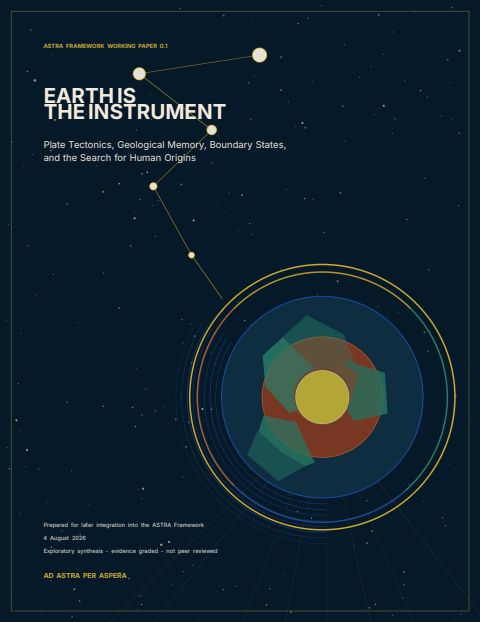
Overview and original PDF
The paper proposes that Earth is an active coupled system whose interfaces can store history, select pathways, transform matter, and determine which evidence survives. It treats plate boundaries as evolving subsystems, connects geological environments to chemical selection, and frames geology as both archive and censor.
Here, instrument means a natural coupled system that stores, transforms, filters, and reveals evidence—not a claim that Earth was engineered.
Text-first accessibility
The PDF is searchable and has embedded fonts, working bookmarks, and links. It is not a tagged PDF: headings, lists, tables, formulas, links, and figures lack a semantic structure tree, and the figures lack machine-readable alternatives. This browser page is the immediate text-first companion. It supplies the scientific boundaries, reading map, evidence vocabulary, and all eight figure descriptions; it does not claim that the fixed-layout PDF itself is accessible.
Report an accessibility or reading problem after removing secrets, private paths, account details, and non-public data.
Questions the paper develops
- How do plate boundaries behave as evolving planetary interfaces rather than passive lines on a map?
- How might linked geological settings create a distributed nursery for prebiotic chemistry?
- Which processes write, erase, expose, or bias the geological and archaeological record?
- What measurements would distinguish a physically possible mechanism from one that operated historically?
Gaps in geological or archaeological preservation constrain what can be recovered; they do not provide positive evidence for a particular civilization or technology.
Reading map
- A ground reading
- Seven signals from 2026
- Plate tectonics as a planetary boundary system
- Before biology: a distributed geological nursery
- Life becomes geology
- Geology as archive and censor
- The submerged human archive
- Monuments as reorganized geology
- Candidate origin stories
- The ASTRA research program
- Conclusions
- Compact claim ledger, audit questions, and references
How to read the evidence labels
| Label | Meaning in this working paper |
|---|---|
| Established | Repeated observation or strong support from direct measurement and mature theory. |
| Strong inference | The best explanation of convergent evidence, with revisable details. |
| Plausible | Physically and historically coherent, with partial supporting evidence. |
| Open | Not excluded, but not materially favored by current evidence. |
| Constrained | Possible only in narrow forms because expected evidence is absent or contradictory. |
| Unsupported | No positive evidence currently requires the claim. |
These labels are the author's classifications, not peer review, scientific consensus, or institutional endorsement. They grade support inside this exploratory paper and are not dispositions in the SPPT/ASTRA v1.0.7 claim-admission matrix.
Figure descriptions
- Seven 2026 signals: seven labeled research areas surround an interface node, illustrating the shared lesson that interfaces can select pathways, retain history, and reorganize effects without implying one shared mechanism.
- Plate-boundary classes: side-by-side diagrams compare divergent, convergent or subduction, and transform settings while noting that real margins combine stress, fluids, mineral reactions, and changing geometry.
- Distributed geological nursery: cosmic inventory and multiple geological environments connect to coupled replicators, showing an origin network rather than one privileged location.
- Boundary-state ladder: a vertical sequence runs from planetary differentiation through tectonic and living interfaces to external memory, material cosmologies, and a spacefaring phase.
- Geology as archive and censor: a narrowing funnel follows lived history through deposition, preservation, exposure, and recognition to the much smaller observed record.
- Monuments as reorganized geology: geological and ecological materials pass through quarrying, sorting, heating, carving, plating, and dyeing into the Giza complex and the Ark-Tabernacle literary and material tradition.
- Candidate origin stories: a text-labeled matrix grades candidate stories across physics, geochemistry, biology, archaeology, and distinctive predictions; the labels carry the meaning, not color alone.
- ASTRA instrument test: an operational chain runs from source through coupling, state change, output, residue, and prospective prediction, with a failed prediction required to revise the mechanism rather than the evidence.
Editorial and scientific notes for version 0.1
- The abstract's “published or reported in August 2026” should be read as available by August 2026. Several cited papers were accepted or published in June or July; their DOI records are authoritative.
- References 1 and 2 were accepted Physical Review Letters papers at the document date. Reference 3 was online ahead of its assigned September 2026 issue.
- The seven 2026 studies motivate a shared analytical lens. They do not establish a common mechanism or validate ASTRA.
- The recurring caption form “Figure 2.1.:” is a punctuation defect, not a change to figure numbering or meaning.
- The Ark-Tabernacle discussion analyzes literary and material traditions. It does not establish a particular artifact's historicity or demonstrate an electrical device.
These notes preserve the supplied paper while making known boundaries visible rather than silently rewriting the immutable v0.1 PDF.
Integrity and publication record
Publication normalization corrected the visible page-label sequence, redirected ten premature navigation targets to their visibly typeset headings, and replaced repair-history metadata with stable document metadata. It did not alter page text or graphics: all 44 source and published pages were rendered at the same resolution and compared pixel-for-pixel with no differences.
- Supplied PDF SHA-256
1982d988981e046ed3b083835144fb83d4e98b2dca92454903472c265f4e7220- Published PDF SHA-256
d0eaf61661e69395a6f3895167abb55d7b801480391f672966d359194e9b46d0
The page assets are rebuilt from the immutable release only after the annotated tag, exact four-asset roster, GitHub asset digests, tag-bound checksum file, and all three payload hashes verify.
Citation
The repository-level CITATION.cff describes the core SPPT/ASTRA v1.0.7 reference release, not this historical supplemental paper.
ASTRA Framework Working Paper. (2026). Earth Is the Instrument: Plate Tectonics, Geological Memory, Boundary States, and the Search for Human Origins. Working Paper 0.1. GitHub. https://github.com/jkolantree/astra/releases/tag/earth-instrument-wp-0.1
Rights and provenance
The repository owner supplied the PDF and explicitly authorized its public distribution as an ASTRA supplemental resource. Version 0.1 contains no separate copyright or reuse license, so no reuse license is asserted for the PDF or cover image. Cited publications remain under their own terms. The cover is a 480 by 622 pixel rendering derived from the supplied PDF's first page; no independent rights or provenance claim is made for that companion image.
The PDF embeds subsets of Inter and EB Garamond under the SIL Open Font License 1.1, Latin Modern Math under the GUST Font License, and DejaVu Sans under the DejaVu, Bitstream Vera, and Arev terms. If redistributing the PDF, preserve the accompanying font notices.