Astronomical State-Topology and Reservoir Analysis
What can response reveal about what we cannot see?
ASTRA studies hidden connectivity, phase, memory, and observation. Begin with the phenomenon, keep more than one explanation alive, and make each candidate answer to a test.
Start with what reaches the boundary
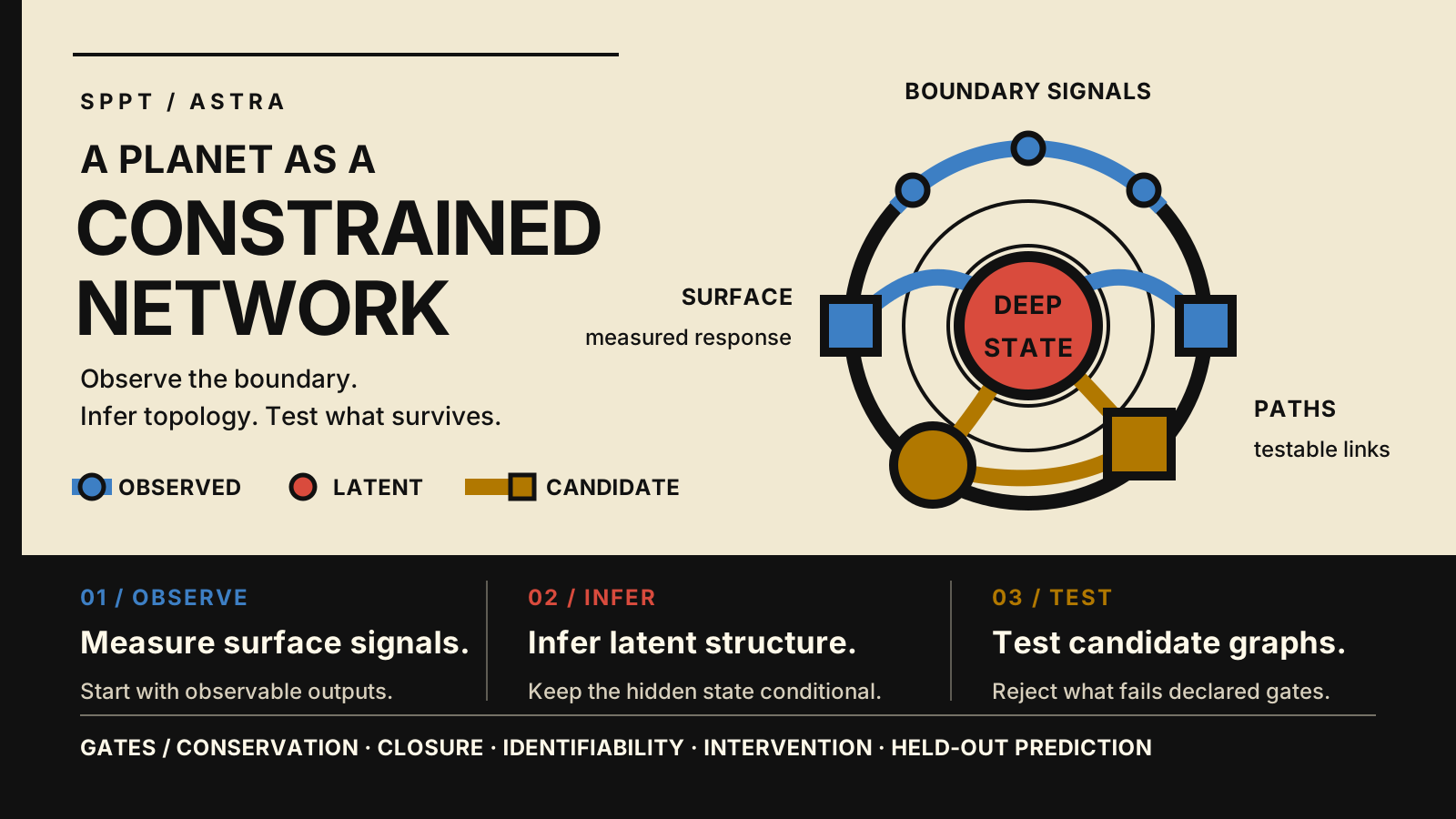
A planet, laboratory sample, detector, or cosmic system rarely reveals its full interior. We see temperatures, light, motion, fields, composition, and delayed change. Two hidden structures can produce the same snapshot, while a transient, second measurement channel, or intervention may separate them.
SPPT describes material and energy reservoirs joined by constrained physical paths. ASTRA asks which candidate connections, phases, histories, and observation operators survive conservation, identifiability checks, counterexamples, and held-out prediction.
Reading order: observe boundary signals and measured responses, infer a conditional latent state, then test candidate graphs against declared gates. Open the full-size vector. This is a conceptual map, not an observation or scale model.
Read now
Current · core reference · v1.0.7
Phase-Reservoir Topology as a Hidden State Variable in Planetary Evolution
Reservoir networks, exact conservation results, state-dependent transport, identifiability limits, and reduced synthetic tests. Different hidden networks can produce the same surface response, so fit quality alone does not select a unique interior.
Path, Compensation, Memory, and Observation asks what an unseen sector would do before deciding what to call it. It separates gravitational role, collective charge response, and preferred-frame claims, then develops conditional derivations and held-out discriminators.
A static picture can hide the mechanism. A transient can reveal a timescale. A second channel can break an equivalence. A missing signal can reject a model when the instrument had enough power to see what that model predicted.
The Dark-Medium Response Atlas applies that habit to dark-sector questions. Dark matter names a gravitational deficit, plasma names collective charge response, and aether names a preferred-frame claim. One sector could play more than one role, but the names do not establish identity. The Atlas’s gravitational-pulse, microwave-synthesis, and Centaur cases transfer inference structure only: restored controls need not restore state, fitted parameters can compensate, and delayed output can carry hidden history.
Choose the record you need
Read: use the versioned editions above. Namespace-local latest/ routes are conveniences, not citation targets.
Download: use the tagged release attached to the selected publication.
Cite: the repository-level citation belongs only to SPPT/ASTRA v1.0.7. Each Working paper carries its own citation metadata.
Reproduce: follow the selected publication’s runtime, source archive, and package-local instructions.